Lean Mean Posing Machine
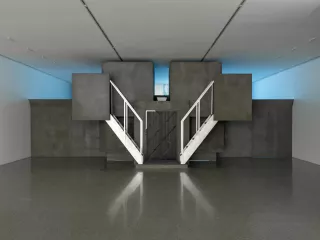
Lean Mean Posing Machine is a geometric work in white marble representing a bench whose clean lines are only broken by the black marble armrest. Used in sculpture since ancient times, marble refers to a tradition and heritage in artistic practices. In the collective imagination, this material evokes sculptures dating from antiquity to the modern period. The tradition of marble is broken by the extremely sober aspect of the bench, which refers to minimalism. This form evokes both everyday and museum furniture. Lean Mean Posing Machine is intended to disturb, to cause the viewer to wonder whether or not they can sit on this bench, whether or not it is a work of art. Shahryar Nashat once again plays on this magnetism, on this attraction that art objects can exert on bodies. He questions the classification of contemporary art, which sometimes takes unclassifiable forms, as well as the limits that the artist may or may not cross.
Text written by Elise Vassiliadis-Poirey as part of the partnership between the École du Louvre and Lafayette Anticipations – Fonds de dotation Famille Moulin.
Exhibitions
Palais de Tokyo, Paris (France)
from 20 Oct to 23 Nov 2014

Shahryar Nashat a développé un intérêt précoce pour la vidéo qui occupe aujourd’hui une place importante dans son travail. Il mêle ce médium à la sculpture, à la photographie ou au mobilier pour créer des œuvres qui jouent sur la relation entre les objets et les corps des visiteurs. Ces derniers sont au cœur de sa création, l’artiste s’attachant à étudier le magnétisme que les objets d’art peuvent exercer sur les corps. Shahryar Nashat utilise des formes génériques, notamment des cubes et des polygones, dont il questionne la place dans l’espace muséal tout en explorant les relations entre elles et avec les visiteurs.
Né en 1975 à Téhéran (Iran), Shahryar Nashat a étudié à l’école supérieure des beaux-arts de Genève. Il a reçu le prix Lafayette en 2013. Il vit et travaille à Berlin.