Polder (sara)
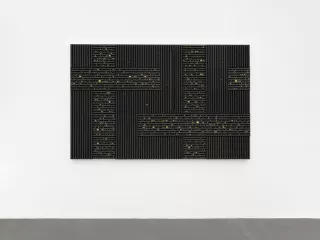
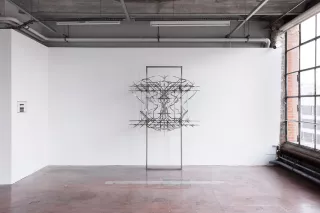
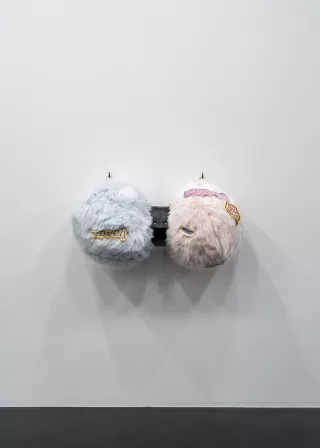
When asked about the definition of the word “polder,” Tatiana Trouvé explains: “This term contains the idea of a reclaimed space and a completely artificial space. The polder is set up where there should be nothing.” The experience proposed by the polder is therefore to extract oneself from the present space and to project oneself into a mental space, a past, an imaginary space. The polders always have a strong link with the architecture in which they are embedded. Through the use of construction pipes, Tatiana Trouvé tends to show what is usually camouflaged and thus to produce what she calls “X-rays of architecture,” seeking to capture the soul and interiority of buildings. The cold and silent environment of Polder (sara) is made up of disparate elements surrounded by black rubber bands that seem to have been borrowed from the world of office automation although their primary use is unclear. The accumulation of tins also evokes the world of the kitchen and domesticity. A hybrid space, it is too large to be a model, but too small to be usable. Access to one of the rooms is blocked by strips of the same rubber that encloses all the objects, thereby frustrating the viewer.
Text written by Marianne Tricoire as part of the partnership between the École du Louvre and Lafayette Anticipations – Fonds de dotation Famille Moulin.
Exhibitions
MAMCO - Musée d'Art moderne et contemporain de Genève, Genève (Suisse)
from 25 Jun to 21 Sep 2014
La Galerie des Galeries, Paris (France)
from 01 Oct to 29 Oct 2005
FRAC PACA, Marseille (France)
from 29 Jan to 02 Apr 2005
Galerie Georges-Philippe & Nathalie Vallois, Paris (France)
from 04 Oct to 09 Nov 2002
Tatiana Trouvé

Born in 1968 in Cosenza, Italie
La pratique de Tatiana Trouvé s’articule autour des notions de mémoire et d’archives. L’artiste cherche notamment à sauver de l’oubli des éléments banals, des documents administratifs et des objets divers qui constituent le cœur de notre quotidien. Nourrie d’influences littéraires, son œuvre protéiforme à mi-chemin entre la sculpture, l’architecture et la maquette matérialise son expérience intime tout en montrant l’absurdité de la société contemporaine et du monde du travail.
Née en 1968 à Cosenza (Italie), Tatiana Trouvé a été formée aux Pays-Bas ainsi qu’à la Villa Arson de Nice avant de se lancer dans son principal projet artistique : le Bureau d’activités implicites (BAI). Elle a remporté le prix Marcel Duchamp en 2007. Elle vit et travaille à Paris.