Plugin-Rhyzome
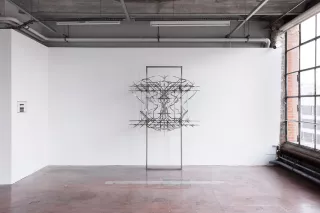
Made of reinforced concrete, steel, and raw oak, Plugin-Rhyzome is an expression of tension. The cables that criss-cross the piece extend out from an octagonal cylinder fixed to a column. In this way, the work sculpts the space in which it is located. Faced with the lightness of the networks it creates, one almost forgets the weight of the materials chosen by the artist. Ethereal, the work appropriates elements usually used in architecture to “occupy a space and define it” (Marie Chênel), in a manner reminiscent of Richard Serra’s work and the theories of Rosalind Krauss. The work “plugs in” and, by imposing itself on the exhibition space, reveals and transforms it. Despite its monumental scale, Plugin-Rhyzome can be dismantled and transported from one space to another to generate new spaces and question our relationship to them.
Text written by Camille Philippon as part of the partnership between the École du Louvre and Lafayette Anticipations – Fonds de dotation Famille Moulin.
Exhibitions
École supérieure des Beaux-arts de Nîmes (Esban), Nîmes (France)
from 09 Jan to 08 Feb 2023
La Maréchalerie, Centre d'art contemporain de Versailles, Versailles (France)
from 22 Jan to 22 Mar 2014
Jennifer Caubet

Born in 1982 in Tonneins, France
Jennifer Caubet s’intéresse à l’architecture, dont elle utilise les matériaux bruts et les formes dans sa pratique sculpturale. Ses œuvres questionnent l’espace qu’elles occupent et qu’elles ne cessent de créer puisqu’elles sont déplaçables. Les « utopies réalisables » (Yona Friedman) de Jennifer Caubet s’inspirent des architectures théoriques du collectif Archigram, mais aussi du travail de Constant et des théories de l’Internationale situationniste. Adaptables et politiques, ses sculptures peuvent être réactivées pour conquérir de nouveaux espaces et remettre en question « l’être au monde » (Marie Chênel).