Chromatic air, Tomoko Sauvage
This composition, entitled Chromatic Airand created especially for the exhibition, engages with Yu Nishimura’s pictorial landscapes and extends their evocative atmospheres.
Since 2006, Tomoko Sauvage has been developing Waterbowls, an electroacoustic instrument comprising, amongst other things, porcelain bowls filled with water, microphones and natural objects. Her work explores the acoustic properties of water and the vibrations produced by its movement.
The audio recordings incorporated in this piece were made possible through the generous support of The Renaissance Society, Chicago (engineered by Jane Askew) and bohemian drips, Berlin.
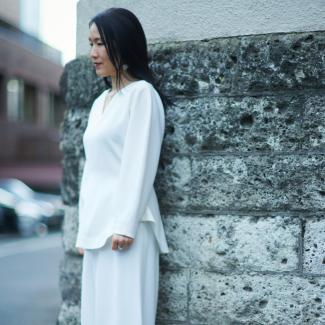
Tomoko Sauvage is a Paris-based Japanese composer and artist who is best known for her long-time musical and performance practice on her original instrumentarium assembling water, ceramics and electronics.
She animates the inanimate through tuning water and vessels, making them vibrate and magnifying their tiny sounds that are otherwise quasi-inaudible. Her work centers on tactile materiality of vibrant objects, metaphorical listening and the use of the chance as a compositional method.
For two decades, she has been performing internationally at institutions and festivals such as Barbican Centre (London), Palais de Tokyo (Paris), Maerz Musik (Berlin), Musée d’art moderne (Paris), Haus der Kunst (Munich), Nyege Nyege Festival (Uganda) and Wonder Cabinet (Palestine). Her installation and video works have been shown at Sharjah Art Foundation, Portland Institute for Contemporary Art.
Sauvage has developed her original musical instrument, Waterbowls, by initially drawing inspirations from the traditional South Indian instrument, Jaltarang. Her long-term experimentation, enlivened by a tactile research on properties of materials, transformed water-filled porcelain bowls into an aqueous electroacoustic instrument. She animates the inanimate through tuning water and vessels, making them vibrate and magnifying their tiny sounds that are otherwise quasi-inaudible. In her amplified waters, Sauvage plays with water drops and waves, clay, stones, shells and glass objects as idiophonic or membranophonic instruments and often in combination with bubbles that are used to create a kind of underwater aerophones. Sauvage’s active use of acoustic feedback, a phenomenon generally considered troublesome, has led her to engage in an encompassing approach to the architecture, the acoustic space and the presence of all matters within. Her role as a performer can be interpreted as a gardener who controls the controllable, leaving the chance to unfold the rest.