L'eau du jardin
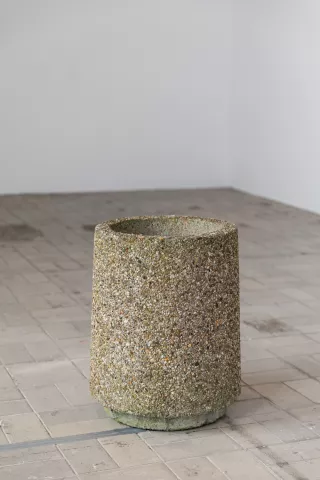
Étienne Bossut is particularly receptive to the beauty of mass-produced industrial objects: metal drums, piping elements, tyres, and gas bottles are among his favourite motifs. Using his favoured process of reproduction by hot moulding, for this piece he uses a can, an everyday, trivial, and industrial object, to which he gives dignity by using multiple examples and seeking chromatic harmony amongst them. He thus avoids any illusionistic effect by modifying the colour of the object used as a model. The title of the work, which is always meaningful for the artist, imbues the sculpture with a form of poetry by recalling the primary function of the moulded object: to contain water. Bossut’s sculptures capture a lost state of the object they imitate. They are artefacts in an archaeology of the present time and of industrial society.
Text written by Marianne Tricoire as part of the partnership between the École du Louvre and Lafayette Anticipations – Fonds de dotation Famille Moulin.
Exhibition
La Galerie des Galeries, Paris (France)
from 13 Sep to 03 Nov 2007
Etienne Bossut

Born in 1946 in Saint-Chamond, France
Étienne Bossut réalise ses sculptures d’objets ordinaires – sièges, bidons, frigidaires,, couteaux de cuisine, etc. – avec des moulages en polyester teinté dans la masse. En conférant un nouveau statut à ces objets industriels, il les déplace du champ de la consommation vers le domaine de l’art. Le résultat, d’une vérité trompeuse, explore la porosité entre la copie, l’imitation et la création tout en incitant le spectateur à questionner son rapport aux objets.
Né en 1946 à Saint-Chamond (France), Étienne Bossut a été diplômé de l’École des Beaux-arts de Saint-Étienne en 1970. Ses œuvres font partie de nombreuses collections publiques françaises. Il vit et travaille à Rennes (France).